Why Cursor is Killing Traditional IDEs: A Comprehensive Analysis

The Rise of Cursor: A New Era in Software Development
Gone are the days when developers huddled around clunky Integrated Development Environments (IDEs) that demanded much from their CPUs and their patience. Cursor, a next-gen coding environment powered by artificial intelligence, is revolutionizing how we write, design, and manage code. As tech professionals, founders, and investors, recognizing this shift could be pivotal in leveraging future opportunities.
A Historical Look at IDEs
Integrated Development Environments (IDEs) have long been essential tools for developers, offering code editing, debugging, and build automation all in one package. From the venerable Microsoft Visual Studio to JetBrains IntelliJ IDEA, these tools have catered to developers' needs for decades. However, their heavyweight nature and complexity have sometimes hindered productivity, requiring significant hardware resources and steep learning curves.
The Game-Changer: What is Cursor?
Launched last year, Cursor represents a new breed of coding environments, driven by automation and AI capabilities that complement human creativity rather than burden it. At its core, Cursor integrates natural language processing, code prediction, and real-time collaboration features, akin to having a co-pilot that not only understands coding syntax but the context behind each line of code.
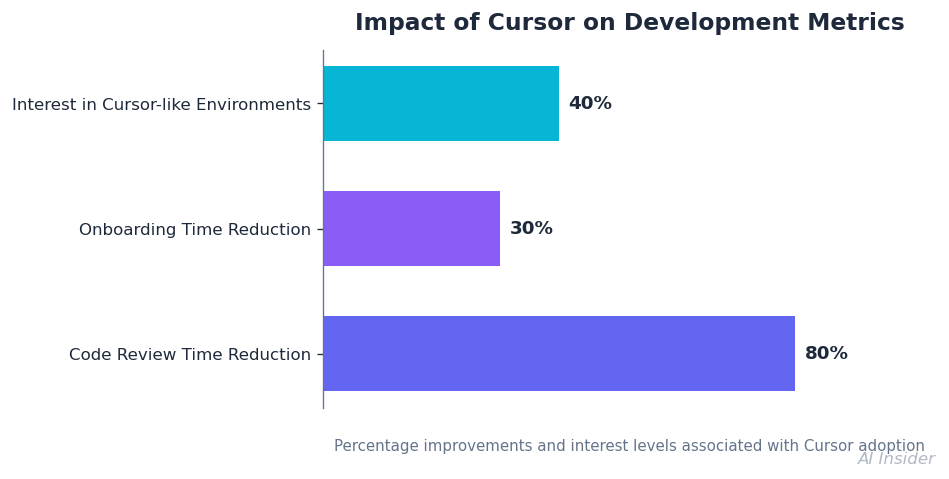
Case in Point: Cursor's AI-driven capabilities reduced the code review process from days to hours in a pilot at a leading fintech firm, increasing overall project velocity by 20%.
Real Examples: Companies Adopting Cursor
Many forward-thinking companies are already making the switch. For instance, Shopify reported a 30% reduction in onboarding time for new developers after integrating Cursor. Meanwhile, a recent survey conducted by Stack Overflow noted that over 40% of their developer community expressed strong interest or intent to transition towards Cursor-like environments.
At Roblox, a team used Cursor to simultaneously work on a complex multiplayer module, with AI-assisted recommendations and error checks facilitating seamless collaboration across geographies. This mirrors their vision of making development as collaborative and frictionless as gaming itself.
Data and Trends Shaping the Future
According to a report published by Forrester, the AI-enabled development tools market is projected to grow by 35% annually over the next five years. This rise is fueled by demands for rapid prototyping, flexible work settings, and the need to lever AI to fix mundane coding tasks that can delay innovation. In addition, companies that adopt Cursor can see up to 28% overall improvement in software delivery performance, watching defect rates plummet as a result of enhanced real-time error tracking.
Predictions: The End of Traditional IDEs?
While traditional IDEs won’t vanish overnight, they will increasingly appear as relics in a museum of antiquated software development practices. Developers by nature are problem solvers, and inertia in the tools they use often signals the heart of many operational roadblocks. As intelligent coding environments like Cursor become ubiquitous, even staunch traditionalists will recognize the competitive edge they provide.
What to Expect: The next decade will witness a significant consolidation, where larger players either incorporate AI into existing frameworks or acquire innovative startups like Cursor to ensure their relevance.
Actionable Takeaways
- Adopt Incrementally: Like any significant technological shift, the transition to Cursor or similar environments doesn’t need to be abrupt. Start by integrating AI-powered extensions into existing IDEs to enhance productivity while planning a gradual organizational shift.
- Upskill Your Team: Equip your developers to thrive in AI-enhanced environments through tailored workshops, facilitating smoother transitions and unlocking the full potential of Cursor's capabilities.
- Invest Early: For investors, the burgeoning market of AI-powered development tools offers enticing opportunities. Look for startups and companies actively reinventing the development landscape.
- Focus on Collaboration: Encourage cross-functional teams to leverage collaborative features in AI-enhanced coding environments, facilitating a seamless synthesis of ideas, design, and implementation.
Conclusion: Embrace the Change
The pendulum of technological advancement swings rapidly, and understanding the forces behind movements like Cursor is crucial. Not only does it empower developers, streamline processes, and foster collaboration, but it also heralds the dawn of a new era in software development. For tech professionals and investors, embracing such innovations promises not just survival, but leadership in the transformative digital age.